
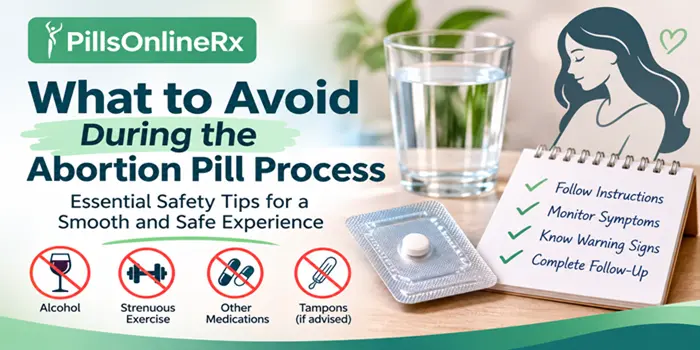
Taking abortion pills involves more than following a medication schedule. Understanding what to avoid before, during, and after taking the medications can help you prepare for expected symptoms, prevent unnecessary discomfort, and recognize potential complications.
Can you exercise after taking abortion pills? Should you avoid certain medications? Is it safe to have sex, drink coffee, or use tampons? What should you do if you experience unexpected symptoms between the two medications?
The answers depend on the stage of the process, your medical history, and the medications involved.
This guide explains what to avoid during the abortion pill process, why certain precautions matter, which common restrictions are not universally necessary, and when to seek medical attention.
Medical note: This article provides general educational information. It does not replace individualized medical advice. Follow the instructions provided by your prescribing healthcare professional.
What Should You Avoid During the Abortion Pill Process?
The most important precautions include:
- Taking abortion medication without checking your eligibility and medical history.
- Changing the prescribed timing or taking additional doses independently.
- Ignoring severe bleeding, persistent fever, or intense abdominal pain.
- Taking other medications without checking for possible interactions.
- Skipping recommended follow-up or pregnancy confirmation.
- Ignoring symptoms that could indicate an ectopic pregnancy or another complication.
Other activities, including eating regular meals, showering, walking, and light exercise, generally do not need to be restricted.
Understanding these precautions at each stage can help you make better-informed decisions.
1. Before Taking Mifepristone: Avoid Overlooking Medical Eligibility
Before starting a medication abortion, it is important to establish whether the prescribed regimen is appropriate for your pregnancy and medical history.
The commonly used two-medication regimen combines:
- Mifepristone: Blocks progesterone, a hormone needed to maintain pregnancy.
- Misoprostol: Causes uterine contractions that help expel pregnancy tissue.
The FDA-approved regimen is indicated for an intrauterine pregnancy through 70 days (10 weeks), calculated from the first day of the last menstrual period.
Before starting, avoid overlooking these medical considerations:
Suspected or confirmed ectopic pregnancy
An ectopic pregnancy develops outside the uterus, commonly in a fallopian tube. Mifepristone and misoprostol do not treat ectopic pregnancy.
Seek medical evaluation if you experience symptoms such as severe or one-sided abdominal pain, shoulder-tip pain, fainting, or unusual dizziness. These symptoms require assessment, particularly when pregnancy location has not been established.
An intrauterine device (IUD) in place
An IUD must be removed before starting the FDA-approved mifepristone regimen. Discuss removal and treatment timing with a healthcare professional.
Certain medical conditions
Mifepristone may not be appropriate for people with:
- Chronic adrenal failure.
- Long-term systemic corticosteroid treatment.
- Certain bleeding disorders or anticoagulant use.
- Inherited porphyria.
- Known allergy or intolerance to mifepristone or misoprostol.
These conditions require clinical assessment because they can affect medication safety.
What to do instead: Provide accurate information about your pregnancy dates, medical history, current medications, allergies, and any symptoms to your healthcare professional before starting treatment.
2. Between Mifepristone and Misoprostol: Avoid Changing the Medication Schedule
Mifepristone and misoprostol perform different functions. Taking them according to the prescribed schedule is important for the effectiveness of the regimen.
For the FDA-approved regimen through 70 days of pregnancy:
| Medication | FDA-approved instructions |
|---|---|
| Mifepristone | 200 mg orally on Day 1 |
| Misoprostol | 800 mcg buccally, 24–48 hours after mifepristone |
Avoid these medication-related mistakes:
- Taking misoprostol earlier or later than instructed.
- Skipping misoprostol without medical guidance.
- Taking additional tablets because bleeding has not started.
- Changing the prescribed administration route.
- Repeating the regimen without clinical assessment.
- Bleeding may not begin immediately after mifepristone. Many people experience the more noticeable cramping and bleeding after taking misoprostol.
If you vomit shortly after taking mifepristone, contact your healthcare professional for instructions rather than automatically repeating the dose. The same applies if you vomit after misoprostol or are unsure whether you received the complete dose.
Important: If you have taken mifepristone but have not yet taken misoprostol, do not independently change or discontinue the regimen. Contact your healthcare professional for guidance.
3. Avoid Taking Other Medications Without Checking for Interactions
Not every medication is appropriate for every person during medication abortion. Your existing prescriptions, medical conditions, and bleeding risk can influence which medicines are suitable.
Pay particular attention to:
- Blood thinners: Anticoagulants can increase bleeding concerns and require medical review.
- Aspirin: Can affect platelet function and may increase bleeding risk. Do not use it for abortion-related pain unless specifically advised.
- Long-term corticosteroids: These are particularly important to disclose because chronic systemic corticosteroid therapy is a contraindication to the FDA-approved mifepristone regimen.
- Other prescription medicines: Ask your healthcare professional or pharmacist about possible interactions and contraindications.
What about pain relief?
Nonsteroidal anti-inflammatory drugs (NSAIDs), including ibuprofen, are commonly recommended for medication abortion-related cramps when appropriate.
Acetaminophen may also be an option for some people, depending on their medical circumstances.
Before taking pain medication:
- Follow the recommended dosage.
- Check for allergies and other contraindications.
- Avoid combining medicines containing the same active ingredient.
- Ask your healthcare professional if you have kidney disease, stomach ulcers, bleeding disorders, or other relevant conditions.
Do not stop prescribed medication or take additional abortion medication without professional guidance.
4. After Taking Misoprostol: Avoid Ignoring Heavy Bleeding and Severe Pain
Misoprostol causes uterine contractions that help expel pregnancy tissue. Cramping, bleeding, and blood clots are expected parts of this process.
However, severe symptoms should not automatically be considered normal.
Seek emergency medical attention if you:
- Soak through two full-size sanitary pads per hour for two consecutive hours.
- Experience severe abdominal pain that does not improve with recommended pain medication.
- Faint, collapse, or experience severe dizziness.
- Develop symptoms suggesting significant blood loss.
Other symptoms require prompt medical assessment:
- Fever of 100.4°F (38°C) or higher that persists for more than four hours.
- Fever or feeling seriously unwell that develops or continues more than 24 hours after misoprostol.
- Foul-smelling vaginal discharge.
- Persistent or worsening abdominal pain.
- Serious infection can occasionally occur without a fever. Feeling extremely unwell, experiencing severe abdominal pain, or developing signs of circulatory problems should never be dismissed simply because your temperature is normal.
Do not wait for symptoms to worsen before seeking medical care.
5. Avoid Strenuous Exercise When You Feel Unwell
Light physical activity is generally acceptable during medication abortion. However, strenuous exercise may be uncomfortable when you are experiencing heavy bleeding, cramping, fatigue, or dizziness.
Consider temporarily limiting:
- High-intensity workouts.
- Heavy weightlifting.
- Long-distance running.
- Physically demanding household chores.
- Activities that worsen weakness or dizziness.
Do you need complete bed rest?
No. Routine bed rest is generally unnecessary. You can usually continue normal activities as you feel comfortable.
Listen to your body, take breaks, and stop activities that make your symptoms worse. If you experience severe dizziness, weakness, or unusually heavy bleeding, seek medical attention rather than trying to rest through the symptoms.
6. Avoid Vaginal Douching and Unnecessary Vaginal Products
Vaginal douching involves flushing the vagina with water or other solutions. It is unnecessary after medication abortion and can disrupt the natural vaginal environment.
Avoid:
- Vaginal douching.
- Scented internal cleansing products.
- Unprescribed vaginal medications.
- Products marketed to cleanse or detoxify the uterus.
- Normal external hygiene with water and gentle cleansing is sufficient.
If you notice unusual discharge, persistent irritation, or an unpleasant odor, contact a healthcare professional rather than attempting internal cleansing.
What about tampons and menstrual cups?
Sanitary pads are useful during the heavier bleeding phase because they make it easier to monitor blood loss.
However, a universal prohibition on tampons or menstrual cups is not established for every patient. Follow your individual aftercare instructions and use pads when you need to monitor bleeding more closely.
7. Avoid Alcohol and Recreational Substances When Experiencing Significant Symptoms
Alcohol is not universally prohibited during medication abortion. However, avoiding it during the most symptomatic part of the process is a sensible precaution.
Alcohol may:
- Worsen nausea or stomach discomfort.
- Contribute to dehydration.
- Increase dizziness.
- Make it harder to recognize symptoms.
- Affect judgment when deciding whether to seek medical assistance.
- Recreational substances can also affect alertness and judgment. Some may interact with medications or make it harder to monitor your condition.
Practical advice: Avoid alcohol and recreational substances while experiencing significant cramping, bleeding, nausea, or dizziness. Check with your healthcare professional about possible interactions with your medications.
8. Avoid Skipping Follow-Up and Pregnancy Confirmation
Bleeding and cramping do not independently confirm that medication abortion is complete.
Follow-up helps establish whether the treatment worked and whether additional medical care is needed.
Depending on the treatment plan, confirmation may involve:
- A follow-up consultation.
- A specially timed home pregnancy test.
- Blood tests measuring human chorionic gonadotropin (hCG).
- An ultrasound when clinically indicated.
Why shouldn't you take a pregnancy test immediately?
Pregnancy hormone levels can remain detectable for several weeks after a successful medication abortion. An ordinary home pregnancy test taken too early may still show a positive result.
Follow the testing schedule recommended by your healthcare professional. If pregnancy symptoms persist, bleeding does not occur after misoprostol, or you are uncertain whether the abortion is complete, seek medical guidance.
Routine in-person follow-up is not necessary for every uncomplicated medication abortion. However, having a reliable method of confirming completion and knowing when to seek care are important.
9. Avoid Being Unprepared During the Misoprostol Phase
Misoprostol commonly causes the most noticeable symptoms during medication abortion. Cramping and bleeding may become more intense as the uterus contracts and expels pregnancy tissue.
Preparing your surroundings beforehand can make the process easier to manage.
Consider keeping these essentials nearby:
- Full-size sanitary pads.
- Comfortable clothing.
- Drinking water and light meals.
- A heating pad or warm compress.
- Your healthcare professional's contact information.
- Access to transportation if emergency care becomes necessary.
If possible, arrange for a trusted person to be available for support.
You do not necessarily need someone physically present throughout the process, but having a practical support plan can reduce stress and help you access assistance if needed.
10. Avoid Following Unnecessary Restrictions on Everyday Activities
Not every activity needs to be prohibited during medication abortion. Some commonly repeated restrictions are not universal medical requirements.
Here is a practical comparison:
| Activity | General guidance |
|---|---|
| Eating regular meals | Generally allowed |
| Drinking water | Encouraged |
| Drinking coffee | Generally allowed in moderation |
| Taking a shower or bath | Generally allowed |
| Light walking | Generally allowed as tolerated |
| Normal daily activities | Resume as comfortable |
| Strenuous exercise | Reduce if symptoms interfere |
| Ibuprofen | Commonly recommended when appropriate |
| Aspirin for pain relief | Avoid unless specifically advised |
| Tampons and menstrual cups | Follow individual aftercare instructions |
| Sexual activity | Follow clinician guidance; no universal waiting period applies to everyone |
| Alcohol | Best avoided during significant symptoms |
| Vaginal douching | Avoid |
| Additional abortion medication | Never take without medical guidance |
The most important considerations are your symptoms, medical history, prescribed regimen, and healthcare professional's instructions.
What Can You Generally Do During the Abortion Pill Process?
Knowing what to avoid is only part of preparation. Many everyday activities can continue during medication abortion, depending on how you feel.
You can generally:
- Eat regular meals and maintain hydration.
- Take a shower or bath.
- Walk around and perform light activities.
- Rest whenever you feel tired.
- Use a heating pad for abdominal cramps.
- Take recommended pain relief medication.
- Ask for emotional and practical support.
There is no need to restrict every aspect of your daily routine. Your comfort and symptoms should guide your activity level.
When Should You Seek Medical Attention?
Knowing which symptoms require medical attention is one of the most important parts of medication abortion safety.
| Symptom | Recommended action |
|---|---|
| Soaking two full-size pads per hour for two consecutive hours | Seek emergency medical attention |
| Severe or persistent abdominal pain | Contact your provider urgently |
| Fever of 100.4°F or higher lasting more than four hours | Seek prompt medical assessment |
| Fever or feeling seriously unwell more than 24 hours after misoprostol | Seek prompt medical assessment |
| Fainting or severe dizziness | Seek emergency care |
| Foul-smelling vaginal discharge | Contact your provider |
| No bleeding within 24 hours after misoprostol | Contact your healthcare professional |
| Persistent pregnancy symptoms | Arrange follow-up assessment |
Mild chills, temporary fever, nausea, and diarrhea can occur after misoprostol. However, persistent or worsening symptoms should not automatically be attributed to medication side effects.
If you suspect an emergency, do not wait for a response from your regular healthcare provider. Seek emergency care.
Frequently Asked Questions
1. Can I eat normally during the abortion pill process?
Yes. There is generally no need to follow a special diet during medication abortion. You can eat regular meals and drink water. Smaller, lighter meals may be easier to tolerate if you experience nausea.
2. Can I drink coffee after taking abortion pills?
Generally, yes. Moderate coffee consumption is not universally prohibited. However, caffeine may worsen nausea, stomach discomfort, or anxiety in some people. Consider reducing your intake if you experience these symptoms.
3. Can I take ibuprofen after taking misoprostol?
Ibuprofen is commonly recommended for managing medication abortion cramps when there are no individual contraindications. Follow your healthcare professional's dosage instructions and check before taking it if you have kidney disease, stomach ulcers, or other relevant conditions.
4. Can I sleep after taking misoprostol?
Yes. Rest and sleep are generally fine. However, make sure you can monitor your symptoms and access assistance if needed. Seek medical attention if you experience fainting, severe weakness, or other warning signs.
5. Can I go to work after taking abortion pills?
It depends on your symptoms and the nature of your work. The misoprostol phase can involve significant cramping, bleeding, and fatigue. If possible, arrange time away from work during the period when symptoms are expected to be most intense.
6. Can I swim after taking abortion pills?
There is no universal evidence-based prohibition against swimming after medication abortion. However, avoid swimming if you feel dizzy, weak, or unwell. Follow any individual aftercare restrictions provided by your healthcare professional.
7. What happens if I vomit after taking an abortion pill?
Vomiting shortly after taking a medication may affect how much of it has been absorbed, depending on the medication and timing. Contact your healthcare professional for specific instructions. Do not automatically repeat the dose.
8. What happens if I accidentally take a medication I was supposed to avoid?
Do not panic. The risk depends on the medication, amount, timing, and your medical history. Contact your healthcare professional or pharmacist and explain what you took. Do not independently change your abortion medication schedule.
9. How long should I follow abortion pill precautions?
The duration depends on the precaution. Some apply mainly during the first few hours or days, while follow-up and pregnancy confirmation may take several weeks. Follow your individual aftercare instructions rather than assuming every restriction lasts for the same period.
Final Thoughts
Knowing what to avoid during the abortion pill process can help you prepare for medication-related symptoms, make informed decisions, and recognize when medical attention is necessary.
Remember these important precautions:
- Review your medical history and eligibility before starting treatment.
- Follow the prescribed medication schedule.
- Check for potential drug interactions.
- Monitor bleeding, pain, and other symptoms.
- Avoid unnecessary vaginal cleansing products.
- Complete the recommended follow-up assessment.
Not every everyday activity needs to be restricted. Rest when needed, maintain hydration, eat normally, and allow your symptoms and healthcare professional's guidance to determine your routine.
Reliable medical information and appropriate healthcare support are important throughout the medication abortion process.